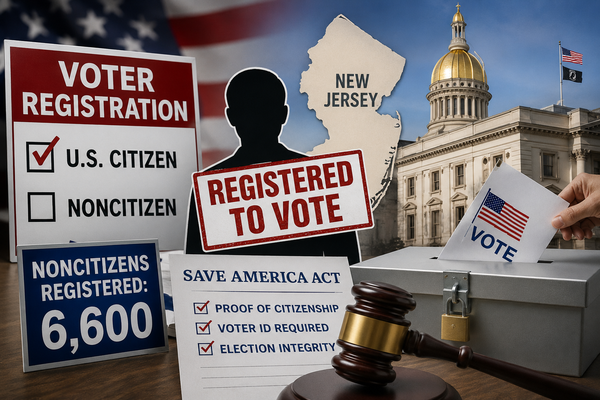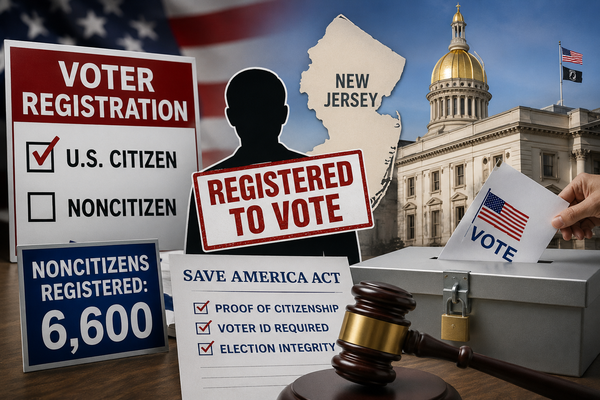
Approximately 6,600 New Jersey residents without U.S. citizenship were mistakenly added to the voter rolls due to an administrative system error. Fewer than 400 of them are believed to have actually cast ballots, reigniting debate over a pending federal bill to tighten citizenship verification for voters.
Governor Michelle Sherrill of New Jersey issued a statement on July 21, saying that from June 2023 to June 2024, a software glitch in the state Motor Vehicle Commission’s system wrongly transmitted non-citizens’ information to election authorities. Although these applicants answered “no” when asked if they held U.S. citizenship while applying for driver’s licenses or ID cards, the system forwarded incorrect data to the voter registration office.
Sherrill, whose administration took office after the error occurred, has instructed legal counsel to investigate the incident. She ordered that the improperly registered individuals be removed from the voter files and that the vendor responsible for the faulty system be replaced.
A preliminary state review found that fewer than 400 of the non-citizens initially registered due to the error actually voted. To date, there is no evidence that their ballots were concentrated in favor of any party or candidate, or that they altered election outcomes. The Associated Press reported that the misregistered individuals were affiliated with Democrats, Republicans and unaffiliated voters alike.
The White House characterized the incident as a consequence of the Democratic-led state’s lax citizenship verification policies. In a press release the same day, officials urged Congress to swiftly pass the “SAVE America Act,” arguing that any illegal vote diminishes the value of lawful citizens’ ballots.
The SAVE America Act would require prospective federal-election voters to submit proof of U.S. citizenship when registering. It would obligate states to regularly purge non-citizens from voter rolls and mandate presentation of photo IDs at federal elections.
Under the bill, mail-in ballot applications and returned ballots would also need to be accompanied by copies of identification. The House of Representatives introduced the legislation in January 2026, and congressional debate is ongoing.
Republicans point to New Jersey’s case as evidence of systemic flaws in the current automatic voter-registration system, which links motor-vehicle applications directly to voter records without adequate citizenship checks—and permitted the error to go undetected for an extended period.
Some Democrats and civil-rights groups counter that non-citizen voting is exceedingly rare nationwide and that mandatory proof of citizenship could disenfranchise eligible voters. They warn that elderly or low-income citizens, and individuals whose names have changed through marriage, might struggle to provide birth certificates or passports on demand.
The episode underscores the challenge of distinguishing between intentional, organized fraud and mere administrative glitches. New Jersey officials noted that the affected residents themselves indicated they were not citizens and that some were registered against their will. Tensions between the state and its system vendor persist over responsibility for the error and data-processing protocols.
The New Jersey voter-registration snafu is likely to intensify political conflict over automatic registration and identity requirements. While ensuring election integrity through citizenship checks is important, safeguards must be designed so as not to curtail lawful voters’ rights.
As Congress considers the SAVE America Act, key issues will include the root causes of the error, the scale of any improper votes, the impact on election results, and how mandatory proof-of-citizenship rules might affect voter access.