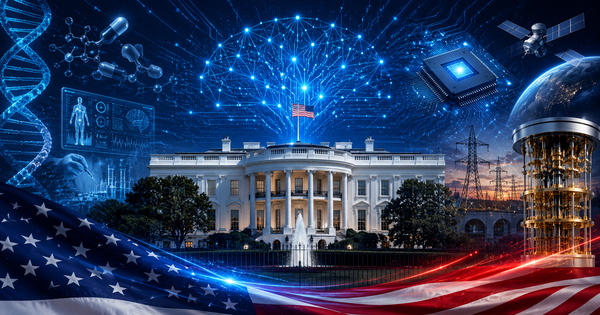
The U.S. government will allocate more than $5 billion in federal funds to leverage artificial intelligence as a core tool for scientific research and industrial innovation. The plan is to establish an interagency research system that applies AI across key national strategic industries, including healthcare, energy, semiconductors, space, quantum technologies, and defense.
On the 22nd local time, the White House announced that it would expand the “Genesis Mission,” investing over $5 billion in federal resources and launching new national science and technology initiatives. The Genesis Mission began in November 2025 under an executive order from President Donald Trump as a countrywide AI science project.
More than 15 federal agencies are participating in this effort, including the Department of Energy, the Department of Health and Human Services, the National Science Foundation, the Department of Transportation, the Department of the Interior, the Department of Agriculture, NASA, and the National Institute of Standards and Technology. Each agency will connect its research funding, scientific data, facilities, and expertise to the Department of Energy’s newly built “U.S. Science and Security Platform.”
In healthcare, long-term health tracking data, environmental data, genomic and clinical information will be combined to analyze the causes of chronic diseases. Supercomputers will be used to study pediatric cancers and rare diseases, and existing drugs will be screened for new therapeutic potentials to shorten drug development and preclinical timelines.
In energy and critical infrastructure, digital twins and AI-based models will be deployed. The government plans to predict the structural stability and maintenance schedules of buildings and transportation facilities, and to analyze power demand and generation to enhance the efficiency and reliability of grid operations.
In the semiconductor sector, an AI-driven co-design framework will be built. By leveraging large-scale manufacturing and testing data, material and process research will be accelerated, aiming to develop ultra-efficient microelectronic technologies for the post-Moore’s Law era. In industrial biotech, data on microbes, chemicals, critical minerals, and autonomous experiments will be integrated to translate research outcomes into fuels, materials, and chemical products.
In space, NASA and the Department of Energy will use AI to analyze over 150 petabytes of data. Data accumulated from telescopes, orbiters, and satellites will be utilized to advance research in astronomy, space weather, and Earth sciences. Autonomous laboratories using robotics and edge AI, as well as the development of fault-tolerant quantum computers, will also be pursued.
The core of this announcement lies not in the scale of investment but in the mode of operation. The U.S. government is linking research data, supercomputing, and experimental facilities—previously distributed across ministries—into a single national platform. This reflects the view that the center of AI competition is shifting from model performance to data, power, semiconductors, research facilities, and expert personnel.
Impacts on Korean industry are also anticipated. As the U.S. consolidates resources in semiconductors, biotech, quantum, and energy at the national level, Korean companies could gain collaboration opportunities with U.S. research institutions. Conversely, the strengthening of U.S.-centric technology standards and data ecosystems may increase pressures toward technological dependence and inclusion in American supply chains.
Korea, too, needs to link data held by government-funded research institutes, universities, hospitals, and public agencies, and establish a system for shared use of national AI computing centers and research facilities. In the future, AI competitiveness is likely to be determined not only by algorithm performance but by how rapidly a country can convert accumulated scientific data and research infrastructure into industrial outcomes.